
Official Statistic in Development on pollinating insect trends
This page hosts the Official Statistic in Development ‘pollinating insect trends’, published on 23 June 2026.
Description
This publication is an Official Statistic in Development. It presents trends for pollinating insect groups, based on data from the UK Pollinator Monitoring Scheme (UK PoMS). UK PoMS is a citizen science monitoring programme that uses standardised methods to collect data on pollinators through a combination of pan trap sampling and Flower-Insect Timed Counts (FIT Counts) of all insects visiting flowers in a 10-minute period. UK PoMS surveys have been running annually since 2017. These statistics are the first to be published from UK PoMS and describe three metrics of change:
- % change from the first to latest year of PoMS (to 2024 in this publication)
- Annual average % change
- % change from the latest year (2024) compared with the average across previous years (2017–2023).
Statistics are presented for broad groups of pollinating insects, as well as for species richness of bees and hoverflies. Separate statistics are presented for each of the UK PoMS surveys. Understanding how pollinator populations are changing is important because these insects play vital roles in natural and agricultural systems, ensuring that many crops and wild plants are able to set seed and produce fruit.
The UK Pollinator Monitoring Scheme is a partnership funded jointly by UKCEH and JNCC (through funding from Defra, Scottish Government, Welsh Government, and DAERA). UK PoMS is co-ordinated by UKCEH, with the following delivery partners: Bumblebee Conservation Trust, Butterfly Conservation, British Trust for Ornithology, Buglife, the Royal Horticultural Society, DAERA and Hymettus, and academic partners the Natural History Museum, the University of Reading and University of Leeds. We are very grateful to all volunteer citizen scientists who participate across the UK, and to the landowners who allow access for PoMS surveys.
Scope
This publication contains results derived from UK PoMS data from England, Scotland, and Wales, and represents surveys from 3,446 sites. Data collection began later in Northern Ireland – as this time series develops, we intend to expand the scope to the UK. The three PoMS surveys involve:
- pan traps within a network of 75 randomly stratified 1 km squares across GB;
- FIT Counts within the same 1 km squares carried out as part of the 1 km survey (“1 km FIT Counts”); and
- “public” FIT Counts that can be carried out anywhere (see Methods section for more detail).
The results are based on data collected from 2017 to 2024 (the full UK PoMS survey period to date), or 2018 to 2024 for the public FIT Counts (which started a year later). Total survey effort (following data cleaning) is summarised in Table 1.
Table 1. Summary of survey effort across the PoMS surveys in GB and all years. Sites in the 1 km square survey network are generally surveyed in all years. Public FIT Count locations vary from year to year.
| Number of 1 km square survey visits | Number of 1 km FIT Counts | Number of public FIT counts |
| 1,592 | 3,313 | 16,027 |
Abundance trends are presented for the following insect groups or summed groups from the pan trap surveys: bumblebees, honeybees, solitary bees, wild bees (summed abundance of bumblebees and solitary bees), hoverflies, sawflies, other flies (all non-hoverfly Diptera, including very small flies < 3 mm), parasitic wasps, social wasps, solitary wasps, butterflies, moths, pollen beetles, other beetles, spiders, small insects (less than 3 mm that could not be identified to another group in the PoMS classification), other insects (that could not be identified to another group, including true bugs) and “all invertebrates”. Note that very small numbers of spiders (which are not insects) were sampled in the pan traps and therefore included here as a group. For this reason, we present the summed abundance of “all invertebrates” from the pan traps. We also present trends in species richness of bees and hoverflies from the pan trap surveys (representing the number of species per sample), where the “all bees and hoverflies” group includes the honeybee (Apis mellifera) as a species.
Abundance trends are presented for the following insect groups or summed groups from the FIT Count surveys (1 km and “public”): bumblebees, honeybees, solitary bees, wild bees (summed abundance of bumblebees and solitary bees), hoverflies, other flies (all non-hoverfly Diptera 3 mm or larger), wasps, butterflies & moths, beetles, small insects (all insects less than 3 mm), other insects (that could not be identified to another group, including true bugs and sawflies) and “all insects” (summed abundance across all groups).
The full set of 16 Tables presenting the results for each insect group by PoMS survey and metric is available to download as an Excel file. Alongside each set of results, a further table is shown to indicate the prevalence of each insect group in the dataset measured as the proportion of surveys in which individuals of each group were detected, and the mean per survey/count across the dataset.
Summary of results
The results present information on three separate metrics for each PoMS survey (see Interpretation and Methods for more detail):
- The first-to-last year percentage change metric is the difference between the predicted (modelled) abundance or species richness in the first and last year of the time series, converted to percentage change. A negative number means that abundance (or species richness) was lower in the last year than in the first year.
- The average annual percentage change metric reflects how abundance or species richness changes on average from one year to the next, so a negative value indicates that abundance (or species richness) has declined more strongly than it has increased.
- The percentage change between the last year and the average of all previous years reflects whether the last year was a “good” or “bad” year compared to all other years on average.
Given the high interannual variability typical of insect numbers and the relatively short time series to date (less than 10 years), the results reported here should be interpreted with caution.
Results for the key pollinator groups are highlighted in Table 2 and show the following:
- Hoverflies declined consistently across all surveys and all metrics. For example, hoverfly abundance declined in the pan trap surveys by nearly 35% between 2017 and 2024 (on average 5% each year), in the 1 km FIT Counts by nearly 26% (on average 4% each year) and in the public FIT Counts by 37% between 2018 and 2024 (on average 7% each year).
- Bumblebees declined in abundance across both surveys on the 1 km squares, for example declining by 27% in the pan traps (on average 4% each year), and by 28% between 2017 and 2024 in the 1 km FIT Counts, although the other two metrics on the 1 km FIT Count showed no change in bumblebee abundance. Numbers of bumblebees in public FIT Counts showed no significant changes in any of the three metrics.
- Species richness of hoverflies and bumblebees also declined in the pan traps across all three metrics (see Table 2).
- Solitary bees showed an increase in abundance and species richness in the pan trap surveys between 2017 and 2024, and in average annual % change, but no change in 2024 compared with the average across previous years (see Table 2). No significant changes in solitary bee abundance were detected in the two FIT Count surveys, apart from a decline in solitary bee abundance on the public FIT Counts in 2024 compared to the average across 2018–2023, suggesting 2024 was a bad year for solitary bees.
- The abundance of honeybees showed no change across all metrics in the pan trap surveys and 1 km FIT Counts, but honeybee abundance increased in the public FIT Counts by 77% between 2018 and 2024 (on average increasing 10% each year).
- The summed abundance of “all insects/all invertebrates” declined consistently across all metrics on the 1 km square pan trap and FIT Count surveys, but the total number of insects counted on public FIT Counts showed no significant changes (see Table 2 and Figure 1).
Results for all other insect groups (including the bees and hoverflies) are presented in Tables 1 to 16 within the Excel file, and Table 3 presents the number of groups showing a significant increase, significant decline or no change in each metric.
The majority of the 18 insect groups showed significant declines in the pan trap surveys for all metrics. Results from the FIT Count surveys were more mixed, with a larger proportion of insect groups having no significant change. However, for the FIT Count surveys on 1 km squares, several insect groups were declining and none were increasing. By contrast, in the public FIT Counts, similar numbers of insect groups were increasing as were declining (see Table 2 and Excel file for more detail and group-level responses).
Of all the insect groups, the “other flies” (classified as all> non-hoverfly Diptera) are the most prevalent in PoMS surveys, being present in 98% of pan trap samples, 68% of 1 km FIT Counts and 50% of public FIT Counts (see Tables 4, 12 and 16 in the Excel file). Other flies showed consistent declines in abundance across all metrics in the pan trap surveys, but no change in the 1 km FIT Counts and increases in abundance across all metrics in the public FIT Counts.
Table 2. Table showing results for the key pollinator groups (bees and hoverflies) and total sum of all insects across each of the PoMS surveys.
| PoMS Survey | Insect Group | % change 2017–2024 [see note a] |
Average annual % change | % change 2024 versus 2017–2023 [see note b] |
| 1 km Pan trap – abundance | Bumblebees | -27.16* | -4.05* | -29.56* |
| Honeybees | 7.71 | 1.66 | -3.62 | |
| Solitary bees | 21.3* | 3.75* | -5.35 | |
| Hoverflies | -34.63* | -5.51* | -12.97* | |
| All invertebrates | -37.26* | -6.37* | -24.47* | |
| 1 km Pan trap – species richness | Bumblebees | -24.97* | -3.78* | -25.02* |
| Solitary bees | 17.03* | 2.95* | -5.33 | |
| Hoverflies | -33.51* | -5.36* | -12.59* | |
| All bees and hoverflies | -18.02* | -2.71* | -12.26* | |
| 1 km FIT Counts – abundance | Bumblebees | -28.48* | -4.48 | -17.37 |
| Honeybees | 42.59 | 5.56 | 16.34 | |
| Solitary bees | -13.21 | -1.55 | -13.86 | |
| Hoverflies | -25.64* | -3.73* | -21.03* | |
| All insects | -27.07* | -4.32* | -14.28* | |
| Public FIT Counts – abundance | Bumblebees | -1.06 | -0.05 | -7.74 |
| Honeybees | 77.86* | 10.38* | 32.78* | |
| Solitary bees | -20.25 | -3.53 | -19.74* | |
| Hoverflies | -37.18* | -6.96* | -22.48* | |
| All insects | -0.65 | -0.05 | 3.33 |
Notes:
- The table presents the three metrics of change described in the text for all bee groups, as well as for hoverflies and the summed abundance of all insects/all invertebrates from each of the PoMS surveys.
- Species richness is a measure of the number of species per pan trap sample. Note that here, the "All bees and hoverflies" group includes the honeybee (Apis mellifera) as a species.
- * indicates the metric is showing a statistically significant increase or decline, based on bootstrapped confidence intervals not overlapping zero.
- Note a: Public FIT Count surveys started in 2018, so this metric represents change between 2018 and 2024.
- Note b: For public FIT Counts this metric represents % change 2024 versus 2018–2024.
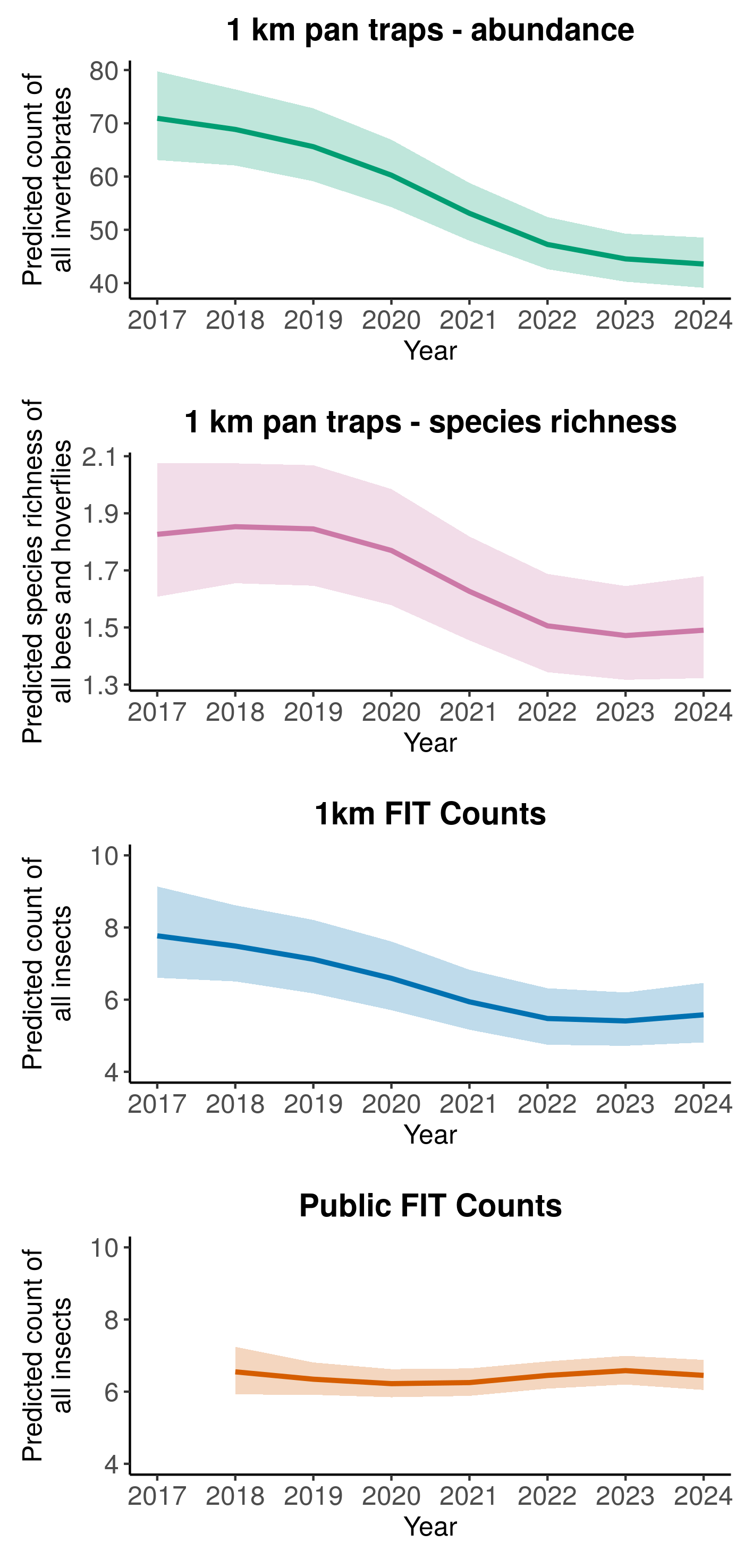
Figure 1. Annual predicted counts and species richness for all invertebrates and all insects from each PoMS survey.
Notes:
- Shaded areas represent the associated uncertainty around the trend, shown using the 95% confidence interval.
- Counts represent the predicted means per pan trap station or per FIT Count derived from the statistical models explained in text.
- Declines in abundance of “all invertebrates” and “all insects” from the pan traps and FIT Counts on the 1 km squares are significant as is the decline in species richness of “all bees and hoverflies”. No significant changes were detected in the summed abundance of “all insects” counted in public FIT Counts.
- Note that the y axis range differs between graphs.
Table 3. Summary of group-level trends across each of the PoMS surveys.
| PoMS Survey | Metric | Insect groups increasing | Insect groups declining | Insect groups with no change |
| 1 km Pan trap (n = 18 groups) |
Abundance: |
1 | 11 | 6 |
| Abundance: Average annual % change |
1 | 10 | 7 | |
| Abundance: % change 2024 versus 2017–2023 |
1 | 12 | 5 | |
| 1 km Pan trap (n = 4 groups) | Species richness: % change 2017–2024 |
1 | 3 | 0 |
| Species richness: Average annual % change |
1 | 3 | 0 | |
| Species richness: % change 2024 versus 2017–2023 |
0 | 3 | 1 | |
| 1 km FIT Counts (n = 12 groups) | Abundance: % change 2017–2024 |
0 | 5 | 7 |
| Abundance: Average annual % change |
0 | 3 | 9 | |
| Abundance: % change 2024 versus 2017–2023 |
0 | 4 | 8 | |
| Public FIT Counts (n = 12 groups) | Abundance: % change 2018–2024 |
3 | 2 | 7 |
| Abundance: Average annual % change |
3 | 2 | 7 | |
| Abundance: % change 2024 versus 2018–2023 |
3 | 3 | 6 |
Understanding different metrics
The three different metrics of change presented have different strengths and weaknesses. Together, they offer different ways to assess how abundance and species richness has changed over the time series.
The first-to-last year percentage change metric tells us how much abundance (or species richness) has changed since PoMS started. This metric is only a snapshot of the time series and can be affected by the specific conditions in the first and last year, while ignoring any changes in the middle of the time series. However, the use of a “smoother” to model interannual changes (see methods section) reduces this sensitivity to particular years including the first and last year by smoothing out much of the interannual variability. The average annual percentage change metric is less sensitive to conditions in any specific year and it reflects changes across the time period. However, it can still mask inter-annual changes as it is an average across all years. The percentage change between the last year and the average of all previous years puts the most recent year of data in context, and reflects conditions during that year. This metric tells us how the last year in the time series compares to an average of all other years, so it does not inform on differences between any two specific years within the time series or trends over time.
While a single metric is desirable for policy and communication reasons, this must be balanced against the loss of information from compressing different types of metrics into a single value. The three metrics reported here are intended to be complementary, and we will be consulting on what is most useful as part of ongoing development (see Development Plan).
Drivers of change
Insects are excellent indicators of environmental change due to their rapid and sensitive responses to habitat or climatic changes. This also creates challenges for modelling their abundance, meaning more time points may be required to detect long-term trends than for vertebrates or plants. The different insect groups monitored under PoMS, and different species within these groups, are also likely to respond to drivers in different ways. As such, the results presented at group level may not represent trends in all species, or trends happening across all parts of Great Britain.
Given the large uncertainty and high inter-annual variability typical of insect numbers, we should remain cautious about interpreting these results in terms of overall declines or increases over this time period. However, several factors are commonly considered to be driving the changes seen in pollinator populations globally and in the UK. These are briefly considered in the context of the changes seen in the PoMS surveys to date.
Weather and climate change
- Weather conditions impact insect development and activity levels, and so can lead to fluctuations in abundance from one year to the next. Met Office Data indicates 2024 was a warm yet unsettled year with high rainfall and below average levels of sunshine (Met Office Annual Assessment). Exceptionally wet weather mid-May was reported in parts of England, Scotland, and north Wales, with some stations recording their wettest May day on record. This is likely to have negatively impacted most pollinator groups. The declines in 2024 compared with previous years recorded on PoMS mirror results from the UK Butterfly Monitoring Scheme and BeeWalk scheme in which 2024 was one of the worst years on record for butterflies and bumblebees respectively in the UK. The hoverflies and some other fly groups may be less impacted by wet years, but may be still recovering from declines in abundance experienced during the hot dry summer of 2022.
- Climate change has longer term implications for insect populations, and is likely to result in different responses across species, which may be explored as the PoMS dataset grows.
Habitat loss, land-use and conservation action
- Many wildlife habitats in the UK have been declining in extent and quality due to land-use change and agricultural intensification, with impacts on the provision of floral resources for pollinators and other resources to support insects throughout their lifecycle.
- The 1 km and public FIT Count surveys sample a different mix of habitats and target flowers, which may partly explain differences in the direction of change for some insect groups between these surveys. Most 1 km FIT Counts (on which abundance of many groups and overall abundance declined) occur in habitats classified as semi-natural (75%) or agricultural (20%). In contrast, public FIT Counts (on which group-level changes were more mixed and overall abundance showed no change), were mainly conducted in gardens (50%, including allotments).
- There is strong evidence suggesting that pollinator populations declined prior to the beginning of PoMS in 2017 (Powney et al, 2019), with habitat loss being the major driver. However, targeted habitat restoration and creation can have positive impacts on species abundance of many mobile insect groups. While PoMS was not designed to measure the impacts of specific conservation or land management actions, the scheme may be able to detect national-level changes in response to these over time.
Methods
See Technical Annex and UK PoMS website for additional information and resources.
Data collection
UK PoMS includes two distinct survey networks from which we report on three surveys:
1 km square survey network (including pan trap surveys and 1 km FIT Counts)
95 x 1 km squares across the UK (75 in GB), stratified to ensure representation of agricultural and semi-natural habitat across each country. The aim is for each square to be visited four times per year, between April and September. During 2024, 71 of the 75 squares in Great Britain were covered, with 249 survey visits in total – this is similar to most previous years. Surveys in the 1 km squares include the 1 km pan trap survey (five sets of coloured bowls filled with water and left in situ for six hours per survey to attract and capture insects) and 1 km Flower- Insect Timed (FIT) Counts of which a minimum of two counts are conducted per survey visit, per square (see survey method below). Pan trap samples are posted to UKCEH for processing.
‘Public’ Flower-Insect Timed (FIT) Counts
FIT Counts involve choosing a patch of flowers (ideally from a target list of 14 plant species or types) and counting all insects visiting the flowers of that plant type within a 50 x 50 cm quadrat over a 10-minute period. Under the public FIT Count, these surveys can be carried out in any location from 1 April to 30 September, and are intended as an accessible introduction to pollinator monitoring that also provides information on plant-pollinator interactions. The public FIT Count dataset includes a high proportion of counts from gardens and urban areas. The FIT Counts in 1 km squares (above) follow the same method.
Validation and Verification
Specimens from pan traps are first sorted to broad insect groups, with bees and hoverflies then identified by professional taxonomists to species level. Verification and cross-checking of a subset of identifications and of any difficult specimens encountered is subsequently carried out to provide quality assurance. Bee and hoverfly specimens that could only be identified to Genus level were included in abundance measures but excluded from species richness calculations. These specimens comprised less than 2% of all samples. FIT Counts are validated by checking the uploaded photographs of every target flower to ensure it matches the species selected on submission, and by following a set of data cleaning rules to check for inaccuracies or extreme outliers in the counts. Detailed information on data validation and verification is given with the published versions of the UK PoMS datasets.
Analysis
We use generalised linear mixed models with a negative binomial distribution to model counts and/or species richness of different insect groups. The effect of year is modelled as a natural spline with three degrees of freedom, acting as a smoother across any interannual fluctuations. The models include several environmental variables collected during the surveys (see Technical Annex), to account for specific survey conditions, such as weather, floral resources, and habitat. We include a random effect for site for FIT Counts and a nested random effect for pan trap station within 1 km square for the pan trap data, to account for between site variation in insect numbers that is not accounted for by the variables in the model. We generate predicted (modelled) counts or species richness from the models as estimated marginal means. From these predictions we calculate the metrics of change and use bootstrapping to derive confidence intervals for these metrics.
Data Availability
The datafiles included with this publication provide the metrics of change from each UK PoMS survey as described above. The underlying data and associated metadata are made available through the Environmental Information Data Centre.
Confidence in results and caveats
The PoMS pan trap and FIT Count surveys each follow standardised methods, which were jointly developed and peer reviewed as part of an initial testing phase (Carvell et al. 2016). This standardisation helps ensure results are comparable over time and between locations. Known potential limitations in data collection are described below, as well as approaches to mitigation. The full set of field and statistical methods used in PoMS are currently in review for publication in an academic journal – also see Technical Annex provided here.
Data collection
- The 1 km square surveys are carried out on the same set of randomly stratified squares each year, with the locations of all five pan trap stations within the square being mapped and fixed over time. FIT Count locations within the 1 km squares can vary according to where suitable target flowers are present. This minimises the risk that results are influenced by varying survey locations annually. The aim is to have four visits per year between May and August, though this is not always possible. In practice, the variability in survey visits is low. The impact is also largely mitigated because we do not model yearly counts, but average number of insects (or species richness) per FIT Count or pan trap sample (one sample equating to the insects sampled at a pan trap station). In this modelling framework unequal sampling effort does not bias temporal trends but is instead reflected in the uncertainty of the estimates.
- The public FIT Count can be conducted in any location with a suitable patch of flowers. This means results could be influenced by volunteer choices about where to record. The impact of this risk is partially mitigated through statistical analyses that include environmental variables such as habitat and flower resources (number of floral units within the 50 x 50 cm quadrat selected for the count). However, residual spatial bias is likely to remain and trends from the public FIT Counts should be interpreted cautiously.
- Weather affects daily insect activity patterns, and so may influence what might be observed during timed counts or collected in pan traps. This risk is mitigated because surveys are carried out only under certain conditions (e.g. thresholds for temperature, and when it is not raining) and by including model variables describing weather conditions at the time of the survey.
- The attractiveness of pan traps to pollinating insects may be influenced by the surrounding landscape and habitat quality. This risk is partially mitigated by including model variables such as floral resources (within a radius of 2 m around the pan trap) and habitat.
Identification
- Specimens collected in pan traps are professionally identified by highly skilled taxonomists, with any likely confusion species undergoing additional checks. The risk of identification error influencing results is therefore very low.
- Results from public FIT Counts are identified to broad insect groups by citizen scientists. Checks on photographic records submitted during initial PoMS development suggest that misidentification rates are unlikely to be sufficiently frequent or systematic to distort GB-scale results – in part because identification to group level has less potential for confusion than species-level identification.
Interpretation
- PoMS is a relatively new survey, which will become increasingly valuable as the time series grows. However, there is strong evidence to suggest that pollinator populations are likely to have declined prior to the beginning of PoMS in 2017 (Powney et al. 2019). It is therefore critical that the more recent trends documented here are interpreted in the context of these longer-term changes.
- The broader group-level changes presented here may mask species-level shifts that have conservation implications. PoMS was not designed to detect individual species-level trends for large numbers of species, though we are exploring the potential for what can be produced (see Development Plan).
- Results at a GB scale may mask trends at the level of individual countries/regions and habitats. We are exploring the potential to generate this type of information as the time series grows (see Development Plan).
Quality Assurance
The approaches used in PoMS have been jointly developed through an initial research development and testing phase and subsequent involvement from the project Steering Group (this includes input from pollinator specialists in each of the four countries – see below). In addition, the results presented here have been quality assured within UKCEH and JNCC and reviewed by representatives from across the PoMS Partnership.
Involvement and Contacts
The statistic was produced by the UK Pollinator Monitoring Scheme partnership with UKCEH having primary responsibility. Quality Assurance was undertaken by UKCEH and JNCC and representatives of the wider partnership. UK PoMS is supported by a Steering Group, which includes JNCC, UKCEH, DAERA, Defra, Natural England, Natural Resources Wales, NatureScot, SASA, Welsh Government. The Steering Group also has representation from the All-Ireland Pollinator Plan and from the EU Pollinator Monitoring Scheme.
Relationship to other Statistics
These statistics form part of a set of statistics produced through monitoring schemes run in partnership between JNCC and a range of organisations. It is intended to complement the UK Biodiversity Indicator ‘Status of pollinating insects’, which reports on changes in species distribution using data from opportunistic citizen science records. By contrast, UK PoMS employs standardised annual surveys of insect abundance to provide information on how broader pollinator groups are changing, as well as insight on species richness changes in bees and hoverflies. We intend to work further to integrate these approaches to give a more effective overall picture of pollinators (see below).
Development Plan
We will consult on and evaluate the statistics produced here, with a view to publication as Official Statistics once this evaluation is complete. In addition to any requirements highlighted during this exercise, we are also intending to prioritise the following:
- The potential for reporting country-level statistics. The main limitation in this respect is that reporting at this scale involves a smaller subset of the PoMS survey network, which reduces the ability to detect trends reliably.
- The requirement and feasibility of producing some species-level trends from the pan trap surveys. This is likely to be limited within the current PoMS survey design due to sample sizes for individual species, but may be possible in some cases, or applicable for groups of species with similar ecological traits.
- Extending the geographic scope to include data from Northern Ireland, when the time series and survey effort become sufficient.
- The potential for reporting pollinator trends by land-use type or habitat, or according to target flower species in the FIT Count survey, again where the datasets allow.
- Integration and alignment with the ‘Status of Pollinating Insects’ UK Biodiversity Indicator. This integration is not straightforward because it involves data collected through a variety of different methods.
References
Carvell, C., Isaac, N. J. B., Jitlal, M., Peyton, J., Powney, G. D., Roy, D. B. et al. (2016) Design and Testing of a National Pollinator and Pollination Monitoring Framework. Final summary report to the Department for Environment, Food and Rural Affairs (Defra), Scottish Government and Welsh Government: Project WC1101. https://randd.defra.gov.uk/ProjectDetails?ProjectID=19259
Powney, G.D., Carvell, C., Edwards, M., Morris, R.K.A., Roy, H.E., Woodcock, B.A., and Isaac, N.J.B.. (2019) Widespread losses of pollinating insects in Britain. Nature Communications. DOI: 10.1038/s41467-019-08974-9
Published: