
 Speaking at a UK Business & Biodiversity Forum (UKBBF) side event at COP17, Dr Gemma Harper OBE, Chief Executive of JNCC, called for greater focus on whether biodiversity evidence is changing the decisions that shape nature's future. She argued that implementation of global biodiversity commitments will depend on action across business, finance and government.
As countries work to implement the Kunming-Montreal Global Biodiversity Framework, discussions at COP17 are increasingly focused on delivery. Addressing delegates at the event, Dr Gemma Harper OBE argued that success will depend not only on measuring changes in the natural environment, but also on understanding how organisations are responding to the evidence.
"The question I'm increasingly interested in is much simpler: are we changing the decisions that determine nature's future?"
Healthy ecosystems underpin economic activity, providing the natural assets and services that businesses rely on, from clean water and healthy soils to resilient supply chains and a stable climate. Organisations that understand their dependencies and impacts on nature are increasingly recognising opportunities to strengthen resilience, support innovation and create long-term value.
Dr Gemma Harper OBE highlighted that while significant progress has been made in understanding the state of nature, there is a growing need to measure society's response to biodiversity loss. Evidence only delivers impact when it informs decisions, influences behaviour and drives meaningful action.
As the UK's statutory nature adviser, JNCC supports governments and organisations by providing the evidence, monitoring and indicators needed to translate biodiversity science into practical decision-making. This work helps connect global ambitions with national implementation and real-world action.
A key example is the UK's biodiversity disclosures indicator, developed as part of the UK Biodiversity Indicators framework. Drawing on publicly available reporting and disclosure data, the indicator provides insight into how businesses are identifying and responding to nature-related risks, dependencies and impacts, helping to track whether awareness is being translated into action.
The event also reflected growing international momentum behind the business and biodiversity agenda. Welcoming the publication of the IPBES Business and Biodiversity Assessment, Dr Gemma Harper OBE described it as an important addition to the evidence base available to governments and businesses seeking to align economic success with nature recovery.
She emphasised that reporting and disclosure are not ends in themselves. Their value lies in helping organisations understand where biodiversity is material to their operations and whether action is being taken in response.
"The question is therefore no longer whether biodiversity is relevant to business. The question is where biodiversity is material to business performance and whether organisations are responding quickly enough."
Looking ahead, Dr Gemma Harper OBE called for greater attention to measuring behavioural and institutional change alongside ecological outcomes, arguing that both will be essential to assessing progress under the Global Biodiversity Framework.
Businesses have a critical role to play. Around the world, organisations are increasingly demonstrating that action for nature can strengthen supply chains, support innovation and contribute to long-term resilience and growth. The challenge now is to ensure that the growing body of evidence on biodiversity is driving decisions at the scale and pace needed to deliver change.
Closing the session, she challenged delegates to focus on whether knowledge is translating into action.
"COP17 will not ultimately be judged by what we know about biodiversity loss. It will be judged by whether that knowledge is changing decisions."
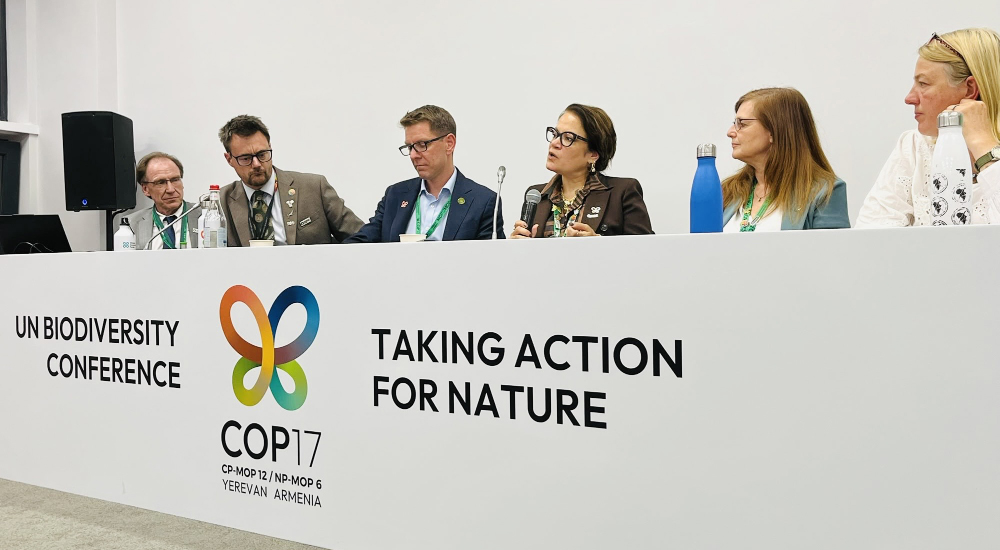
Photograph: Panel at the 'Business Action for Nature: Turning Science and Policy into Practice' side event, from left to right: Mark Johnston, UKBBF; Paul Harrison, UKBBF; Matt Jones, WCMC; Gemma Harper, JNCC; Paula Harrison, UKCEH; Katie-Jo Luxton, RSPB.
To find out more about what JNCC is doing at CBD COP17, visit 'JNCC at COP 17: Delegation Diary'.
Published: