
Published August 2026
The 'Integrating nature’s value into land-use decisions across the UK' Signpost report discusses a possible operating model to catalyse progress towards multifunctional land-use, emphasising the benefits functioning ecosystems provide.
You can also access a copy of 'Integrating nature’s value into land-use decisions across the UK' in PDF format.
Background
The UK’s limited land area faces rising and often competing demands across food, energy and infrastructure. Our overall resilience depends on how we refine and balance these needs while considering supply-chain and climate risks. This report outlines a possible operating model to catalyse progress towards multifunctional land-use, emphasising the benefits functioning ecosystems provide. The approach suggests assessing the cumulative four nations' land-use strategies against overall UK needs, building meaningful regional choice in land-use change decisions, and and co-ordinating the development of spatial evidence that helps make trade-offs visible and delivery measurable. Taken together, these elements could enhance the UK’s resilience and resource security by emphasising the natural benefits land provides and ensuring it is used in ways that safeguard essential supplies, protect critical natural assets and support stable, long-term growth.
Limited land: the case for multifunctionality
The UK has a limited land area within which to meet a broad set of national and international commitments across agriculture, energy, climate, housing and more. These also include goals to protect and restore biodiversity and ecosystems, and the broader roles they help fulfil such as enabling food production and mitigating and adapting to climate change. Achieving these goals will increasingly involve using land for multiple purposes simultaneously, and in a manner that balances the trade-offs of production and development needs with the environmental impacts and constraints of doing so. Getting this balance right could underpin the future resilience of the UK’s land systems and determine the extent to which the UK relies on vulnerable supply chains abroad.
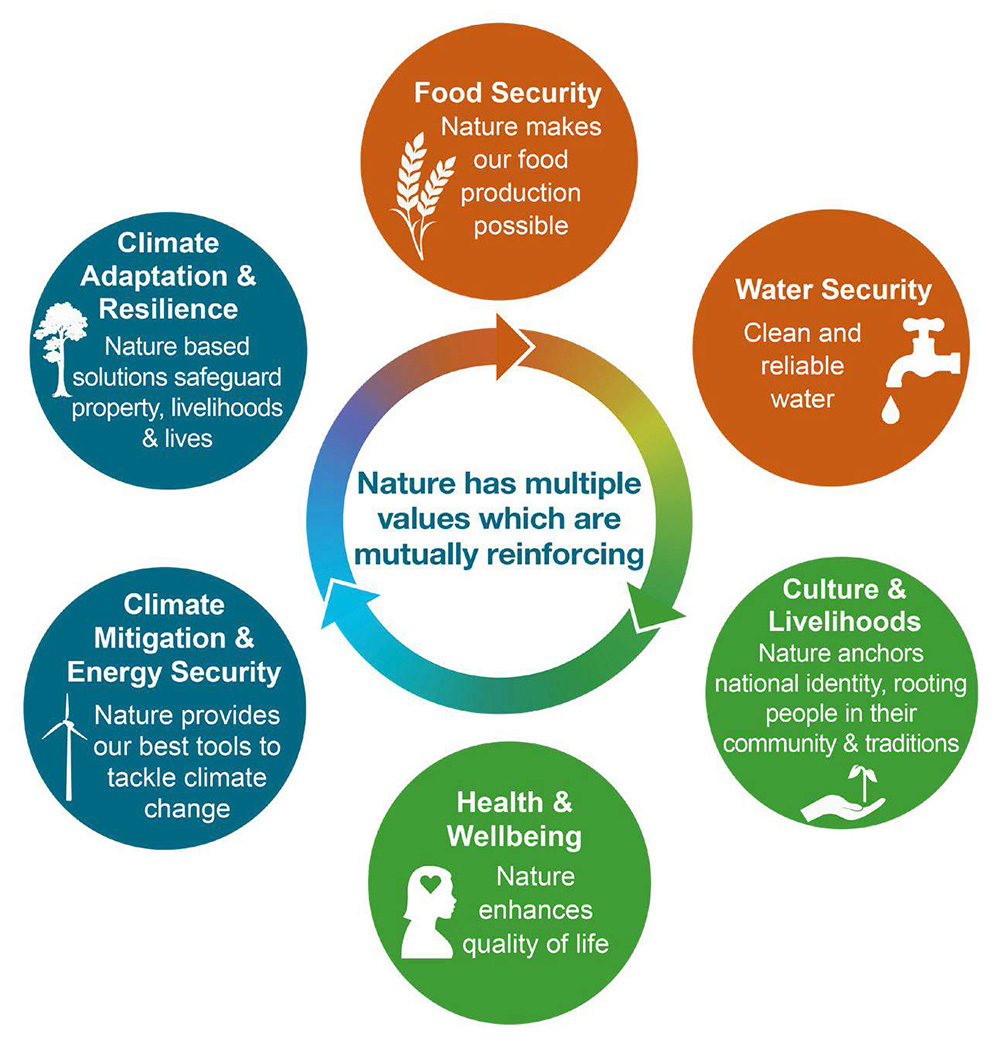
Figure 1. Nature underpins multiple societal benefits that need to be integrated within land-use decisions.
Multifunctional land-use can be described as the capacity of landscapes to deliver multiple, often interdependent ecological, economic, and socio-cultural benefits simultaneously. In delivering it, there is a need to ensure that the mix of these benefits is planned and managed in ways that reflect local opportunities, societal needs, and environmental pressures.
Prioritising co-benefits can minimise trade-offs between climate, nature and food production by reducing the total land area needed to meet associated targets. For example, when land is managed to deliver carbon sequestration, flood attenuation, nutrient retention and habitat connectivity in harmony, the combined benefits exceed those of areas used for a single purpose, while also reducing the risk that its utility could collapse from a single economic, geopolitical or natural shock.
Creating landscapes that deliver integrated outcomes relies on evidence to identify the opportunities and robust governance that incentivises multifunctional delivery. It is not multifunctionality at any cost: management should play to the strengths of the land, and in some contexts a single, well-justified outcome is the appropriate focus. Delivering multifunctionality therefore benefits from locally grounded decision-making aligned with regional and national targets and supported by social science and environmental evidence to help navigate complexities and competing priorities.

Figure 2. Riparian strips potentially deliver a broad range of benefits including timber, carbon sequestration, flood attenuation, nutrient stripping and human health. Identifying where to locate them to maximise the delivery of these benefits is key to making them as cost effective as possible. Image copyright CHUNYIP WONG/iStock
Context of devolution: devolved land-use choices with UK-wide consequences
Devolution enables governments to continue to tailor land-related policy according to the goals and realities of each nation. Decisions over where and how land is changed to meet the scale required by these ambitions, however, also carry consequences for overall UK security. Such changes could potentially reconfigure import patterns both from overseas and between the four nations, thereby reshaping exposure to supply-chain risk and the ability to meet environmental commitments. For example, the four nations share broadly similar policy goals across food, biodiversity, climate and energy, but with geographies that are varyingly suited to each objective. One nation’s decision to incentivise land-use change away from arable land may in turn necessitate that another nation must prioritise agriculture on less productive land to make up import deficits or accept higher reliance on overseas’ imports.
The land-use choices in each nation therefore intersect directly and affect the UK’s overall resilience and efficiency with respect to food, energy, nature recovery and climate resilience. Recognising these interdependencies could support more efficient and resilient outcomes by accounting for the geographic variation in land-use opportunities and constraints within a coherent four nations framework that supports shared goals while retaining national autonomy.
A strong public narrative and local support are further essential for creating sustainable, long-term change in a devolved UK. To deliver targets, it is not just land use that will change, but communities and their cultural attachments tied to that land. It is fundamental that the views and strengths of each country are recognised while still working within a shared UK-wide approach that provides a degree of coordination and alignment. This could increase local input while ensuring national targets are met and recognises that local trust and ownership are a foundation for national resilience and environmental stewardship.
UK-scale levers outside formal policy could improve efficiency and accelerate private investment. A consistent, spatially explicit evidence-base will be key to mobilising these markets, improving efficiency, and enabling cross-border learning through consistent evaluation of outcomes.
Operating model for multifunctional land-use
JNCC’s proposed operating model to facilitate multifunctional land-use comprises three components: assessing cumulative land-use strategies within the four nations against overall UK priorities; a plan to engage with the different sectors of society to enable implementation; and enhancing evidence to direct and assess delivery of the strategy. Together, these elements would help turn high-level ambition into practical, investable programmes that are locally owned, nationally accountable and operationally measurable.
National security depends on having a clear, medium-term view of what to prioritise, especially regarding food, energy, nature recovery and climate resilience. This vision would be further supported with country and regional goals that translate those outcomes into obligations along with investment signals. Having this clarity prevents drift, gives markets confidence, and makes risks easier to see and manage.
Regional choice is where much delivery is likely to occur. Local governments would
continue to decide how they meet their regional goals through their own policies and public investment. Ideally, these decisions would be informed by social‑science evidence about local values, motivations and levels of public support, protecting local autonomy and building awareness of the local benefits of change, while ensuring regional actions aggregate to mitigate national security risks and enhance nature-positive outcomes.
Measurable spatial delivery provides the link between strategy and action. Agreed
frameworks for metrics, spatial prioritisation and real‑time indicators would show where multifunctional land-use delivers greater value. These tools could also enable conditional funding by governments and create the data-streams investors need to secure funding and assess the impact of their investment.
By reducing exposure to supply-chain and environmental risks, this operating model could strengthen the UK’s food, energy and environmental security while ensuring the benefits and burdens of land‑use change are shared fairly and shaped by local priorities.
Proposed steps to enable delivery
Working under the proposed operating model, the following steps set out an approach for accelerating the delivery of multifunctional land-use.
Assess individual land strategies of four nations against UK-wide priorities for nature, climate, food and energy
A potential way forward could be for the four country governments to integrate their priorities for land use into a shared UK picture of overall outcomes. Such view, integrating existing priorities and anticipated future scenarios would enable a review of the scale, interdependencies and risks linked to land-use change across the UK. It could consider the role of land-use change for existing UK-level international targets in climate change and biodiversity and be informed by horizon scanning, particularly regarding climate change and import dependencies. Contributions would likely vary by geography and may benefit from periodic review, while UK-scale clarity on commitments could offer industry greater investment certainty and support more efficient public decision-making.
Support development of regional and landscape plans
Regional, landscape and local priorities will be critical in enabling land-use change, even where national schemes such as agri-environment funding provide support. Sustained engagement with regional and local stakeholders could help identify opportunities and barriers across sectors. Additional funding to strengthen capacity and broaden local support may be important, including both direct public investment and efforts to attract wider sources of finance.
Accelerate private investment
Given the scale of the transition, private finance will play an important role. Industry interest in co-investment is growing, particularly where it helps reduce material business risks. To enable this, governments could provide greater long-term clarity on the direction and benefits of such investment. Clear regional priorities and standardised outcome metrics will further support investor confidence, alongside greater transparency around potential future compliance markets.
Secure societal awareness and engagement for land-use change
Ultimately, the actions outlined above will only succeed with broader societal support. Clear communication of the expected benefits and regular assessment of public perspectives will help maintain trust and participation. A stronger understanding of the drivers of behaviour change may also improve engagement efforts.
Standardise outcome measurement and reporting
As approaches to measuring land-use outcomes evolve, greater consistency across the UK may help improve transparency and efficiency in decision making. Developing UK-wide standards for how outcomes are assessed, while still allowing methods to develop and innovate over time, will improve the efficiency of evidence generation and enhance transparency, supporting better public engagement.
Develop analytical approaches to support decision making
Even with more consistent evidence, decisions involving trade-offs remain complex. Continued development and user-testing of practical, reliable analytical methods will help ensure that emerging tools are reliable and effective in real-world applications, making decisions more evidence-based rather than reliant on personal preferences.
Project outcomes and monitor progress
Regular assessment of progress against overall strategy will help refine delivery over time. There is increasing demand for policies to project their future impacts, not just on their primary objective but across the range of societal outcomes they will affect. Any changes to these outcomes will not be instant but buffered by natural processes and societal responses. They will also be impacted by other policies operating simultaneously. Monitoring to build understanding of the drivers of changes will be key to inform future investment.
Recommendations
- The four governments of the UK should consider establishing and maintaining an integrated view of land use and the benefits it provides, and how this will evolve taking account of climate-change impacts and dependencies on overseas imports.
- Within each country there needs to be a clear plan for engaging society to support land-use transition including agreement on collaborative activities.
- Establish a more consistent cross-border evidence-base to enable and monitor the ongoing transition.
Published: .