
Published November 2025
The 'Restoring agricultural soil for national security and natural capital' Signpost report proposes greater standardisation and collaboration across the public and private sectors to build a better evidence base and accelerate the transition to a more sustainable future management of our soils, thereby improving the overall national security. You can also access a copy of 'Restoring agricultural soil for national security and natural capital' in PDF format.
Background/Introduction
Soil underpins every economy. In a healthy state, it enables numerous benefits critical to national security including food production, flood risk management, and carbon storage. The degraded state of UK agricultural soils, and unsustainable management practices, mean we are missing the full potential of economic and security benefits, however there are opportunities to accelerate initiatives that protect and enhance its resilience. These will require shared action from the public and private sectors to build the evidence and drive restorative practices.
The hidden cost of degraded soil
Agricultural soil is a rich and critical asset that provides economic and security benefits to the UK. This is most understood in respect to its water and nutrient provision to support production from agriculture and forestry, covering 70% of the UK’s land and providing £14.5 billion to the economy (Agriculture in the United Kingdom 2024 (Defra 2025)). Increased understanding of natural capital is shedding light on a much wider set of benefits including mitigating flood risk, storing carbon and supporting biodiversity (see Figure 1).
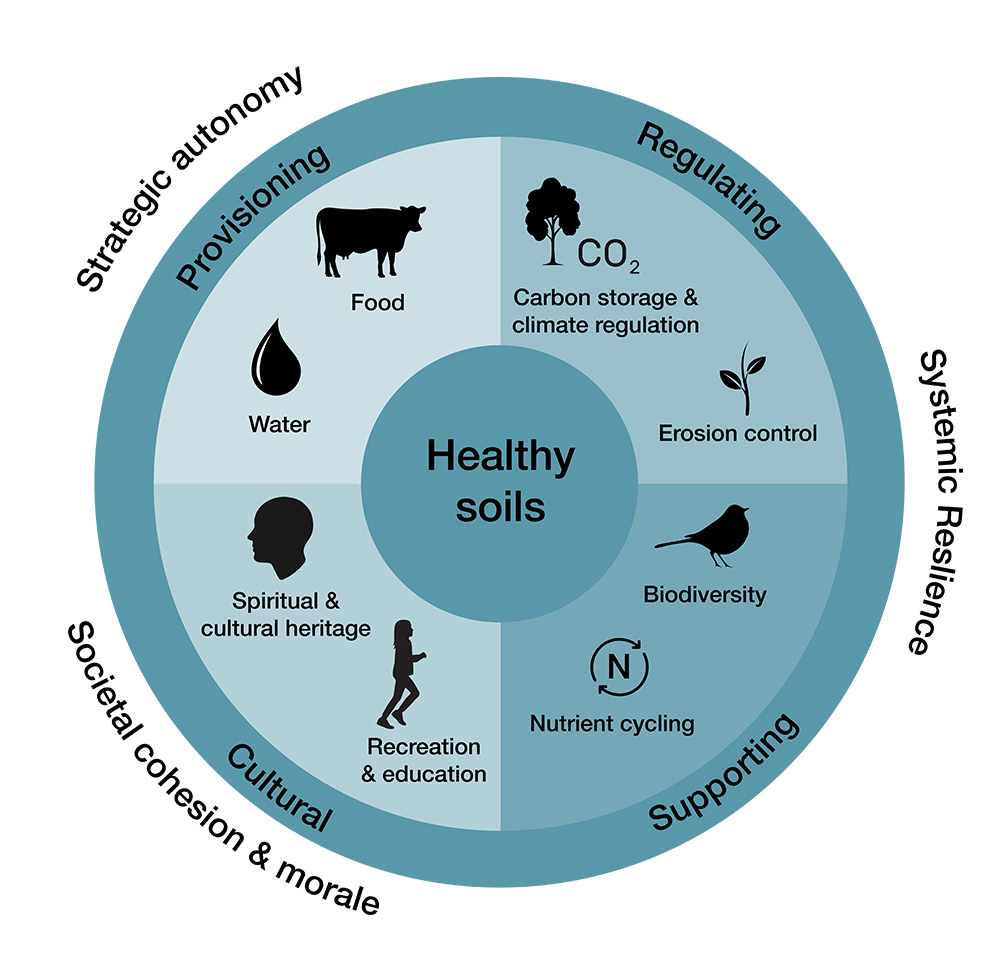 Figure 1. Healthy agricultural soils provide a range of ecosystem service benefits (adapted from NatureScot).
UK agricultural soil is, however, in a widespread declining state of health and current management practices will be unsustainable in the long-term. This includes both the erosion and physical loss of soil and a pervasive reduction in quality, in terms of structure, soil organic matter and biodiversity. It is estimated that damage from erosion, organic matter loss, compaction and pollution is estimated to lead to yield losses of £1.2 billion per year in England and Wales, as well as impacting other ecosystems through associated pollution (Graves et al. 2015). The causes for this degradation include overgrazing, the increasing weight of farm machinery, increasing specialisation of farming systems and the replacement of livestock in arable systems by large applications of inorganic nitrogen fertilisers. Both the causes and consequences of soil degradation could be exacerbated by the increasing frequency of extreme weather events resulting from climate change.
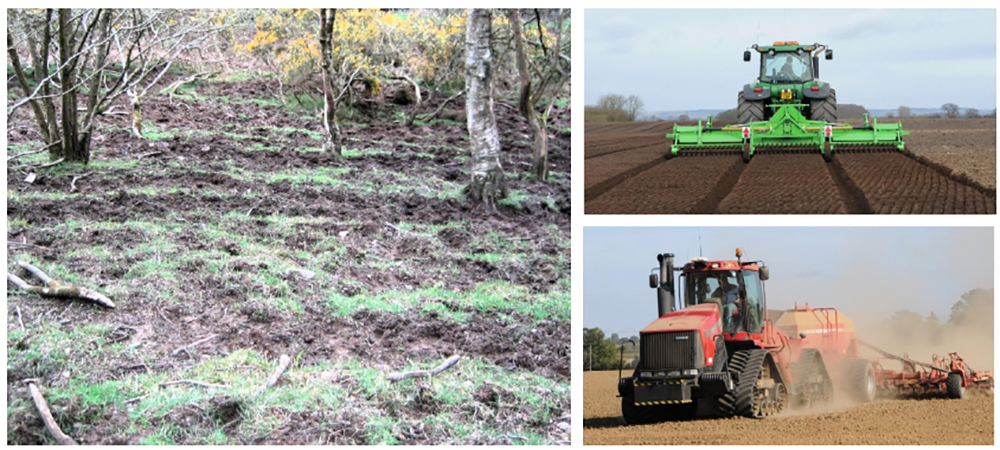
Figure 2. Montage of practices involving soil disturbance: Left – Cattle poaching damage, Sanctuary Wood, Watersmeet (© Natural England/Flemming Ulf-Hansen); Top Right – Tractor and bed former (© Natural England/Peter Roworth); Bottom Right – Intensive arable farming (© Natural England/Peter Roworth).
In tandem, extensive use of chemicals including pesticide and fertiliser use has degraded the structure and functions of soil, which has reduced its ability to cope with extreme and variable weather resulting in greater variability in crop yields. For example, poorly managed soil is less able to absorb and hold rainwater – making it less resilient to drought conditions – and tends to have less extensive natural pest controls – decreasing resilience to the range of pests expected to arrive due to climate change. These chemicals also impact soil’s ability to enhance water quality, mitigate downstream flooding, store carbon and support biodiversity, while also introducing heavy metals into the land and water systems.
The continuation of current soil management practices will also see increasing risks from a geopolitical perspective. The UK relies on imported agricultural crops for 80% our domestic consumption (see Commodity Footprints website), so recent geopolitical and climate instability abroad has already brought attention to the resilience of the UK’s food supply chains. This is compounded by risks to the supply chains of the agrochemicals on which we currently rely for our domestic production methods, which are also vulnerable to global shocks. A secure UK food system therefore requires both stable production at home and reduced dependency on these other inputs.
A different trajectory
There is a need to properly understand the feasibility, benefits and contribution to national security of alternative soil management practices. Many “regenerative farming” techniques tend to restore and protect the natural capital benefits of soil. These less-intensive practices, of which there are already examples in the UK, aim to reduce chemical inputs and make greater use of natural processes and improve overall soil structure. Whilst overall yields from regenerative practices can be lower in the short term, particularly as ecological processes rebuild the soil to its naturally productive state, their resilience in the long-term may balance this out with a more prolonged and stable output. They also restore the wider value of soil for supporting nature, flood risk management, carbon storage, and other services. Soil is intrinsically variable with different soils capable of providing different benefits. It is important this is taken into consideration when adjusting management.

Figure 3. Montage of regenerative faming and soils in conservation: Left – Panaeolus sp of fungi on cow dung (© Natural England/Peter Roworth); Top Right – Dry heath bare ground creation – Ash Ranges 2017 (© Natural England/Des Sussex); Bottom Right – Highland cow grazing (© Natural England/Peter Roworth).
In at least the near to medium term, the UK will likely retain some dependence on import and application of agrochemicals. There is therefore a need to assess the resilience of these supply chains, assess alternative approaches, and develop risk management measures to encourage adoption.
Circular use of alternative farming inputs might play a role in managing this risk. Waste from agriculture and human sewage can be nutrient-rich resources in themselves which may be able to cost-effectively reduce the UK’s dependence on agrochemical fertiliser imports. There are trade-offs; such an approach would need to maximise the benefit from reclaiming nutrients and organic matter for soil improvement whilst minimising and mitigating for the presence of pollutants in these alternatives, such as forever chemicals and microplastics.
Pathway forward
Catalysing the transition requires governments, landholders and other investors to collaborate to assess the risks and opportunities, accelerate the restoration of soil, and reap the natural capital and national security benefits this could bring. JNCC believes the following recommendations form a roadmap to a resilient and secure UK agriculture sector, underpinned by well-understood and well-managed soil:
- Standardise soil evidence: Soil is complex, and its health can be assessed in multiple ways. In a context of devolution, the four governments are taking different approaches to measuring the same thing. Standardising the definition and monitoring of soil health would begin to build a cost-effective evidence base that enables better insight into the risks and opportunities of soil management practices. This could utilise soil standards work already underway by the “Land Use and Net Zero Hub”.
- Establish a data-sharing framework and facility: Data on soil is currently spread between the public and private sector with varying accessibility. Establishing a framework for sharing it, and a facility to co-ordinate this, would unlock more robust analysis and insight. Such a framework would need to be collaborative, transparent and sensitive to private sector concerns, for example providing assurance that private data would not be used to enforce targeted compliance measures.
- Strategically analyse the impacts of soil management measures and use this to predict future outcomes: Assessing the medium- to long-term impacts of traditional and regenerative practices on the benefits soil provides, including productivity, is needed to provide insight on their sustainability in a changing climate. This data and insight should in turn be used to progress predictive modelling capabilities that can identify which will best contribute to national security in the long term.
- Enhance our understanding of global dependencies: A key vulnerability in the UK’s current agricultural systems is the reliance on agrochemical imports. Building a picture of the source of these imports, potentially within a broader assessment of their production and distribution around the globe, would enable clearer understanding of the risks in this dependency. Expanding the scope of JNCC’s Global Environmental Impacts of Consumption (GEIC) indicator could be a cost-effective avenue to achieve this.
- Develop strategies for the management and use of waste to support production: Agricultural waste and human sewage can be resources in themselves, and there is potential to make circular use of these to enhance farm production. Their reuse is, however, complicated by pollutants within them, so there should be a review of the opportunities and feasibility, with sensitivity to any potential human health risks.
- Shape public sector investment to enhance farm level resilience: Once the evidence base is developed to include an understanding of suitable practices and transition costs, an investment plan will be needed to assess and support the transition across the agricultural sector, including consideration of the socio-economics, behavioural analysis of stakeholders and role of other actors such as the insurance sector.
- Develop and enhance international supply chains: The UK will continue to have dependencies on international supply chains but should refine these to adjust and strengthen trading partners to ensure the medium- to long-term resilience of these dependencies.
- Review the outcomes: The move to more sustainable UK production would have a range of benefits not just delivering more resilient production but also improving water quality, reducing downstream flood risk, enhanced carbon sequestration and improvements to biodiversity. A monitoring programme should be established to reassure the delivery of these outcomes.
Published: .