
Positive incentives in place to promote biodiversity conservation and sustainable use
Last updated: 2025
Latest data available: 2024
Introduction
This indicator tracks the number of positive incentives in place in the UK to promote the conservation and sustainable use of biodiversity. Within this indicator, positive incentives are represented by policy instruments, which are tools used by governments to achieve policy goals and influence the behaviour of individuals or organisations. This indicator represents the sum of the number of instruments that are active during each year with data available. The instruments are categorised under five possible headings.
Data for this indicator are extracted from the database on Policy Instruments for the Environment (PINE database) administered by the Organisation for Economic Co-operation and Development (OECD).
Positive incentives help to drive behaviour change in ways that can benefit the conservation and sustainable use of biodiversity, and tracking the number of such policy instruments that are active provides a picture of how these are being used and what types of instruments are being utilised.
This indicator has been published as part of the UK’s response to the Convention on Biological Diversity’s Kunming-Montreal Global Biodiversity Framework (GBF). This indicator relates to GBF Target 18.
Data for this indicator can be found in the published datafile.
Type of indicator
Pressure indicator
Type of official statistics
Official statistic in development. This first iteration of the indicator is reported as part of the UK’s commitment to the Convention on Biological Diversity and the Global Biodiversity Framework. Comments and feedback on the methods chosen are welcome, please email us. For more information, please visit the UK Statistics Authority’s website on types of official statistics – UK Statistics Authority.
Assessment of change
As this is an official statistic in development, an assessment of change has not been carried out for this indicator.
Key results
The instruments included in this indicator are categorised under five possible headings:
- Biodiversity-relevant taxes, fees and charges
- Biodiversity-relevant environmentally beneficial subsidies
- Biodiversity-relevant tradable permits
- Payments for ecosystem services
- Biodiversity offsets
Figure 1 shows the total number of instruments active in the UK per year from 2010 to 2024. The total number has also been subset by the five categories above. The total number of active instruments has changed from 13 in 2010 to 10 in 2024. Most of the instruments in the dataset are categorised as biodiversity-relevant environmentally beneficial subsidies, with none categorised as biodiversity offsets in the current time series.
Figure 1: Number of active instruments in the UK per year that represent positive incentives to promote the conservation and sustainable use of biodiversity, 2010 to 2024
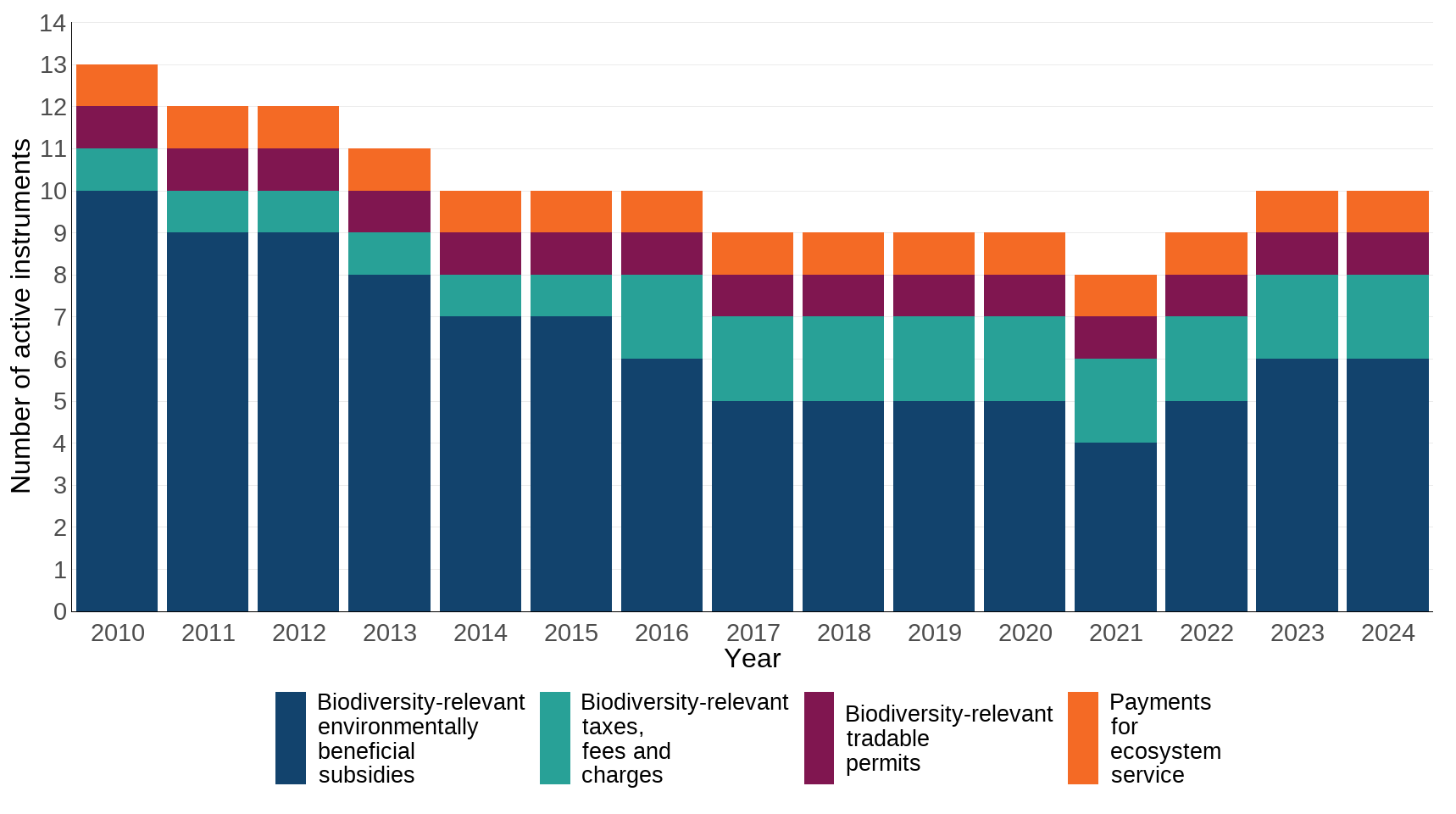
Source: Organisation for Economic Co-operation and Development (OECD) database on Policy Instruments for the Environment (PINE database) (OECD 2025).
Notes about Figure 1
- The number of active instruments in the UK per year is according to the data held in the OECD’s PINE database. Further investigation is needed into the coverage and comprehensiveness of the data for the UK.
- In this first version of the indicator, the time series starts from 2010, therefore allowing comparison with pre-2020 data as an initial baseline for the indicator.
- Each instrument is regarded as being active for at least part of its start and end years, so these are displayed as years when an instrument was active.
- A list of the policy instruments considered for this indicator is included in the published datafile.
- In this indicator the Environmental Stewardship Scheme (ESA) is classed under the payments for ecosystem service category based on detail on its categorisation in the PINE database, while noting that it is also classed under environmentally beneficial subsidies in the PINE database.
Further detail
Positive incentives for the conservation and sustainable use of biodiversity, which are also referred to as economic instruments or incentive-based mechanisms, are fiscally-based or economically-based policy instruments that provide signals to consumers and producers, and encourage behaviour change. More specifically, they discourage activities harmful to biodiversity and encourage activities that benefit biodiversity. In addition, positive incentives also help to mobilise private sector finance for biodiversity, as well as generating revenue.
Positive incentives relevant to biodiversity include specific taxes, fees and charges, environmentally beneficial subsidies, tradable permit schemes, biodiversity offsets and payments for ecosystem services. These positive incentives are important for mainstreaming biodiversity across sectors of the economy and society.
Relevance
Halting the loss of biodiversity requires that policies across government are aligned and aim to minimise the environmental damage that policies might lead to. Many government departments provide subsidies or incentives to change the behaviour of the public or businesses. Article 11 of the Convention on Biological Diversity states: “Each Contracting Party shall, as far as possible and as appropriate, adopt economically and socially sound measures that act as incentives for the conservation and sustainable use of components of biological diversity”. Adoption of the GBF means new consideration is needed to identify and balance the benefits and harms that subsidies and incentives may cause, and to phase out or reform the most environmentally harmful subsidies and incentives.
Target 18 of the GBF commits countries by 2030 to identify and collectively reform, phase out or eliminate USD $500 billion of incentives harmful to biodiversity, and to scale up positive incentives for the conservation and sustainable use of biodiversity.
The UK has a variety of economic and fiscal instruments in place, and has done historically, to encourage the conservation of biodiversity and its sustainable use.
International/domestic reporting
The suite of UK Biodiversity Indicators has been revised and updated to bring it in line with the Kunming-Montreal Global Biodiversity Framework (GBF) of the Convention on Biological Diversity (CBD). Some UKBIs will be used for the forthcoming UK national reports to CBD.
This indicator links to Target 18 in the Global Biodiversity Framework: Reduce Harmful Incentives by at Least $500 Billion per Year, and Scale Up Positive Incentives for Biodiversity.
Web links for further information
Acknowledgements
Thank you to the many people who have contributed by providing data and to the many colleagues who have helped produce this indicator. Specific thanks go to colleagues at the OECD and in the UK Office for National Statistics (ONS).
Technical annex
Methodology
This indicator broadly follows the methodological guidance for GBF headline indicator 18.1. Data for the UK were extracted from the OECD’s PINE database. Before the data were downloaded, the data were filtered by country (United Kingdom) and environmental domain (Biodiversity).
The downloaded data were then converted so that the active status of each instrument was coded for each year in the dataset by using data on the first year that each instrument was effective (start year) and the year that each instrument was discontinued (end year). Start and end years were coded as years when a given instrument was active, as instruments were assumed to have been active for at least part of those years. Where start years were missing and the instrument was labelled as currently active, the instrument was assumed to already be active in the first year in the time series, and where end years were missing for currently active instruments the instrument was assumed to still be active in the most recent year in the time series.
The instrument types in the data downloaded from the PINE database were amended to match the categories required for headline indicator 18.1. The total number of instruments active in each year and the number active under each relevant category were then calculated.
The OECD PINE database started in the 1990s and now covers five policy instrument types across 22 environmental domains. The OECD Secretariat manages the PINE database, undertaking quality checks and ensuring that there is consistency in the way data are classified. The management of the database is overseen by OECD committees and working parties, including the Working Party on Environmental Information (WPEI) and the Joint Meetings of Tax and Environment Experts (JMTEE) (OECD 2024). Currently, there are data from more than 140 countries in the database. Registered expert coordinators are requested to update the data at least once a year, usually in January or February (OECD 2024).
Caveats and limitations
The data reported in this indicator reflect the relevant UK data stored in the PINE database, and some gaps in data coverage might remain.
The instrument categories on ‘Payments for ecosystem services’ and ‘Biodiversity offsets’ have been introduced into the PINE database since 2022, so the data for these two types of positive incentives are likely to be less comprehensive than for the other types of positive incentives (OECD 2024).
Development plan
This is a new indicator. We plan to further develop the indicator during the coming years. We would like to assess the comprehensiveness of UK data in the PINE database, both in terms of the instruments included and the data for each UK instrument.
We are keen to hear from our users about these plans, the language and visualisations used in this indicator, as well as our published development plan for the biodiversity indicators: please email us.
References
-
OECD (2024) Tracking Economic Instruments and Finance for Biodiversity 2024. OECD Environment Directorate: https://www.oecd.org/en/data/insights/data-explainers/2024/10/Tracking-Economic-Instruments-and-Finance-for-Biodiversity-2024.html
-
OECD (2025) Policy Instruments for the Environment (PINE) Database: http://oe.cd/pinedatabase (July 2025 version).
Categories:
Published: